
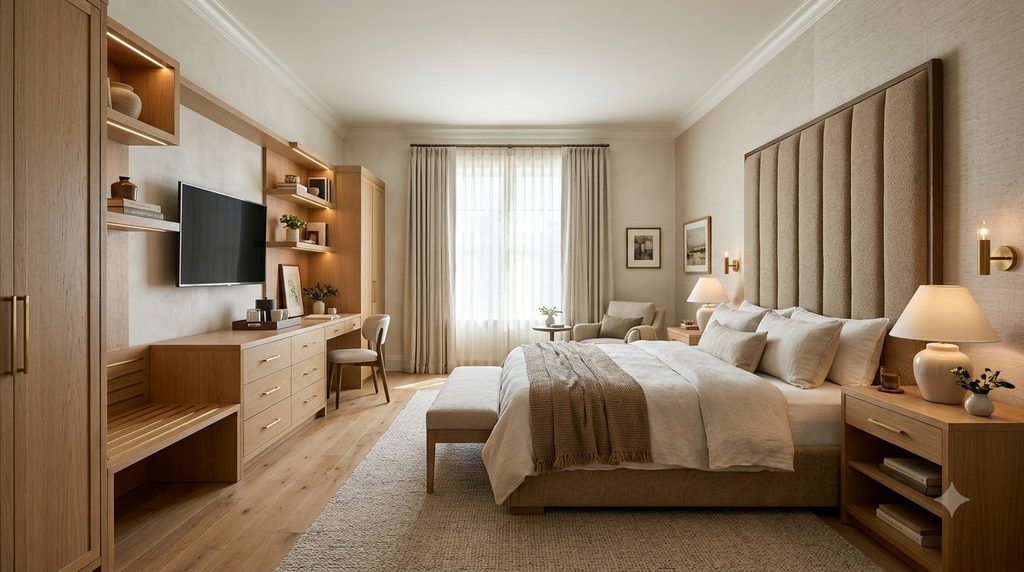
Source hotel furniture from China to Dubai typically takes 4 to 7 months from design sign-off to delivery on site. The route is straightforward, but there are three things which decide whether a project stays on budget. First one is the HS code declared at Dubai Customs, the second one is fire-safety documentation that Dubai authorities expect for upholstered hospitality furniture, and the third one is pre-shipment inspection done before the container leaves China.
What are included on a hotel furniture procurement
Hotel projects normally split furniture into two budget categories:
- FF&E (furniture, fixtures and equipment): This consists of beds, headboards, nightstands, desks, wardrobes, lounge chairs, sofas, restaurant seating, lobby pieces, mirrors, lighting and artwork.
- OS&E (operating supplies and equipment): This includes linens, glassware, cutlery and housekeeping items. These are usually bought separately.
For customs, furniture is classified in Chapter 94 of the Harmonized System (HS):
| HS heading | What it covers | Typical hotel examples |
| 9401 | Seats | Lounge chairs, dining chairs, upholstered sofas, bar stools |
| 9403 | Other furniture | Wooden bedroom furniture, desks, wardrobes, console tables |
| 9404 | Mattress supports and bedding articles | Mattresses, bed bases, duvets, pillows |
| 9405 | Lamps and lighting | Table lamps, wall lights, chandeliers |
| 9406 | Prefabricated buildings | Modular or pod rooms |
The table is just a small reference section for you. The tariff line, which is the full 8-digit GCC code, this code vary depends on material, frame and whether the item is upholstered. Dubai Customs publishes an AI-assisted classification tool called Al Munasiq on its website. Use it, and ask your clearing agent to confirm the code before the supplier issues the commercial invoice. A wrong code can mean a revised duty assessment and a clearance delay.
Why source hotel furniture from China
China is widely cited as the world’s largest furniture exporter. There are major places in china known for sourcing hotel projects.
- Foshan, Guangdong (Lecong, Shunde): This city is the largest cluster for sofas, beds, case goods and contract furniture. Roughly 1.5 to 3 hours by road from Shenzhen (Yantian) and Guangzhou (Nansha) ports.
- Dongguan, Guangdong: The city is strong in hospitality casegoods, custom millwork and upholstery for international hotel brands.
- Anji and Haining, Zhejiang: Anji is known for chairs, Haining for sofas and leather upholstery. Cargo typically ships from Ningbo or Shanghai.
- Trade fairs for supplier discovery: The Canton Fair (Guangzhou, spring and autumn), CIFF Guangzhou (China International Furniture Fair) and the Lecong furniture fairs.
The practical benefits of sourcing furniture from china are custom manufacturing at project volumes, in-house finishing and upholstery, and the ability to build a full sample room before mass production.
Source Hotel Furniture from China to Dubai: Step by step from brief to Dubai delivery
Step 1: Lock the specification package
Issue a written FF&E schedule with drawings, materials, finishes, dimensions, quantities per room type and the hotel brand standard . Add the fire-safety, wood-moisture and formaldehyde requirements here. Changes required after production starts are the most common source of cost overruns.
Step 2: Shortlist and audit manufacturers
Verify the business licence, export record, factory size and references from comparable hotel projects of the manufacturer you selected. Request test reports and ask to see the actual production line also. A third-party factory is standard for large orders.
Step 3: Approve a sample room or prototype

Order the prototypes of the high-risk pieces at first. Furniture items like upholstered headboards, lounge chairs and any mixed-material items are included in this category. It may take 2 to 4 weeks to get the budget range for samples you prepared. For branded hotels, having an interior designer help the smooth planing of the products required and brand’s procurement team should sign off in writing.
Step 4: Agree the commercial terms
Set the Incoterm, payment schedule, delivery window and penalties for delay with the manufacturer before exporting. A common pattern is a 30% deposit is made at first, with the balance paid against the bill of lading copy and a clean inspection report. For large orders, a letter of credit offers stronger protection for both sides.
Step 5: Run mass production with staged inspections
Typical production time for custom hotel furniture is 30 to 60 days after sample approval, it varies depending on quantity and finish complexity. Schedule inspections at roughly 30% and 80% completion, and a final random inspection at 100% packed, using AQL sampling.
Step 6: Obtain fire and quality certificates before shipping
Collect the fire and safety and quality test reports for the actual composites and materials used. Do not wait for arrival in Dubai, complete it before shipping itself.
Step 7: Ship, clear customs and deliver
Book an FCL container where volume allows, file the customs declaration in Mirsal 2, pay duty and VAT, and arrange delivery to the hotel site or a bonded warehouse.
Step 8: Install, snag and document
Schedule installation crews and a snagging list per room. Keep damage photos from the container opening for insurance and warranty claims.
Dubai compliance: what authorities and brands expect
To susccesfully clear furniture on the mainland, the importing company needs a valid trade licence and a Customs Business Code from Dubai Customs. The standard document set is:
- Commercial invoice with the HS code
- Packing list
- Bill of lading (sea) or air waybill
- Certificate of origin, where a preference or origin proof is required
- Any product certificates required for the item
Legalisation requirements for origin documents can change. Confirm them with your clearing agent before shipment.
Fire safety for upholstered hotel furniture
Dubai’s fire framework is the UAE Fire and Life Safety Code of Practice (2018 edition), enforced by Dubai Civil Defence. Dubai Municipality’s Dubai Central Laboratory Department (DCLD) runs fire-safety certification schemes, and the Emirates Safety Laboratory (ESL) issues Certificates of Conformity for certain products that must be registered with Dubai Civil Defence.
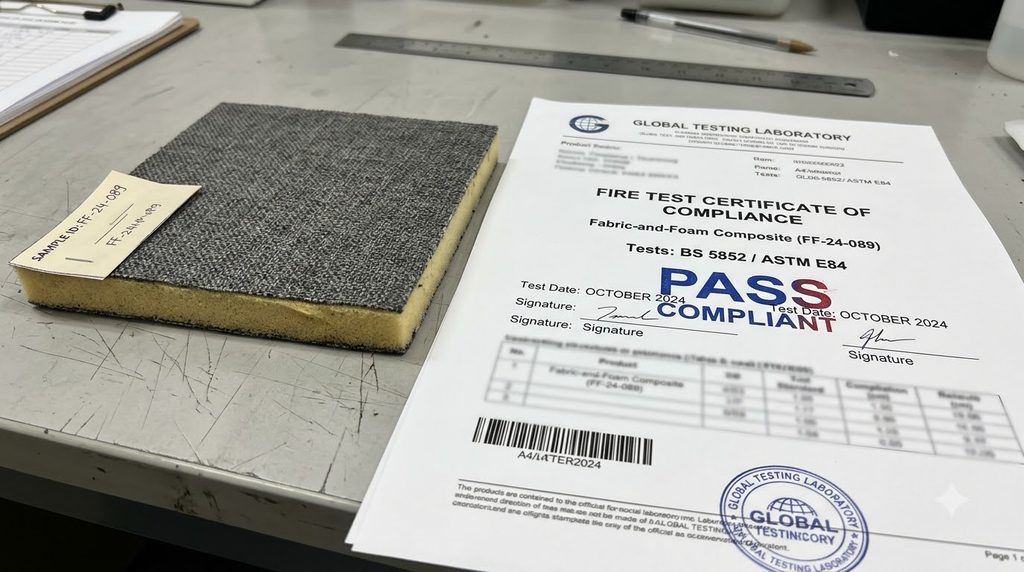
For hotel upholstery, project specifications and fire consultants commonly require:
- BS 5852 ignition source 5 (Crib 5): a flammability test for upholstered seating. BS 7176 classifies hotel bedrooms and public areas as high hazard, which calls for resistance to ignition source 5.
- NFPA 260 as an accepted alternative for fabrics and composites in some specifications.
- Composite testing: Certificates should cover the exact fabric, foam and interliner combination being supplied, not the fabric alone.
Before ordering, ask the project’s fire consultant or the hotel operator which standards apply and which laboratories’ certificates are accepted. Confirm this in writing with the factory so that test reports are issued by a recognised, accredited laboratory in advance.
Wood, packing and material specifications
- ISPM 15: Ensure that the wooden pallets and crates should be heat-treated and marked.
- Moisture content: Check the moisture content of the importing wooden furniture, specify it for kiln-dried wood, commonly 8 to 12%, because Dubai interiors are air-conditioned and dry. Poorly dried timber may warps and cracks.
- Formaldehyde: E1 or CARB Phase 2 compliance is commonly specified for panel products. This is a project requirement, not a universal UAE import rule.
Shipping: routes, transit times and Incoterms
The below days are mentioned just to provide an idea for the sourcing agent to know how a long does a procurement journey usually take.
Typical sea transit times to Jebel Ali
| Origin port | FCL port-to-port (range from published carrier and forwarder sources) |
| Shenzhen (Yantian, Shekou) | 16 to 25 days |
| Guangzhou (Nansha) | 17 to 25 days |
| Shanghai | 18 to 30 days |
| Ningbo | 17 to 26 days |
| Qingdao | 20 to 30 days |
Add 3 to 5 days for customs clearance and trucking from Jebel Ali. LCL adds roughly 5 to 10 days for consolidation too. Transhipment services via Singapore, Colombo or Port Klang can add a week or more compared with direct sailings.
FCL or LCL?
A 40-foot high-cube holds roughly 67 to 68 cubic metres. Choose FCL when you are shipping more than roughly 15 cubic metres, or any delicate upholstered or finished pieces, because fewer handling points mean less damage. Choose LCL for small top-up orders and spare parts.
Incoterms for hotel projects
- FOB (Shenzhen, Guangzhou, Shanghai): you control freight and insurance, and normally get the best visibility. Preferred by experienced procurement teams.
- CIF Jebel Ali: In this the supplier books freight and insurance. Simple, but need to check the insurance cover level.
- DDP Dubai: The supplier handles duty and delivery. Convenient, but it makes the cost structure less transparent, and the supplier must be able to act as importer or use a local partner.
If you would rather not manage freight, inspection and factory coordination yourself, a sourcing partner can handle them. Stories International has an office in Lecong, Foshan, and covers factory sourcing, quality control and shipping for hospitality projects. Whichever partner you use, get every quote in writing with the Incoterm stated, so FOB, CIF and DDP prices can be compared like for like.
Common mistakes happen when source hotel furniture in Dubai and How to avoid them
| Mistake | Consequence | Prevention |
| Wrong or vague HS code | Revised duty assessment, clearance delay | Verify with Al Munasiq and your clearing agent before invoicing |
| Fire test report covers fabric only | Rejected at inspection, costly re-upholstery | Require composite tests on the exact materials supplied |
| No pre-shipment inspection | Defects found only in Dubai | Use a third-party inspector at 80% and 100% |
| Skipping a prototype | Mass-produced errors | Approve a sample room first |
| Under-specified packing | Transit damage | Specify carton drop tests, corner guards and moisture protection |
| Undervalued invoice | Customs valuation dispute and penalties | Declare the true transaction value |
Frequently Asked Questions
How much import duty is charged on furniture entering Dubai? Most furniture is charged 5% of CIF value under the GCC Common Customs Tariff. VAT of 5% applies on top of the duty-inclusive value.
How long does it take to ship furniture from China to Dubai by sea? About 16 to 25 days port-to-port from Shenzhen or Guangzhou and about 18 to 30 days from Shanghai, plus 3 to 5 days for clearance and delivery.
Which Chinese ports are best for shipping furniture to Dubai? Shenzhen (Yantian) and Guangzhou (Nansha) for Guangdong factories, Ningbo and Shanghai for Zhejiang and Yangtze Delta factories. Choose the port closest to the factory with the most direct services to Jebel Ali.
Which fire standard applies to hotel upholstery in the UAE? Projects commonly specify BS 5852 ignition source 5 (Crib 5) or an NFPA 260 equivalent for fabric and foam composites, within the UAE Fire and Life Safety Code of Practice. Confirm the exact requirement with the fire consultant and Dubai Civil Defence.
Do I need a licence to import furniture into Dubai? Yes. The importer needs a valid trade licence and a Customs Business Code from Dubai Customs.
Is it cheaper to import hotel furniture directly from China than buy in the UAE? Often yes for custom or large-volume orders, because factory pricing is lower, but the saving must be weighed against 5% duty, freight, inspection, lead time and compliance risk. Compare full landed cost, not ex-factory price.
What is the difference between FF&ne like JAFZA? Yes. Duty is deferred until the goods enter the UAE mainland, but it is noE and OS&E? FF&E covers durable furniture, fixtures and equipment. OS&E covers consumable operating items such as linens and glassware.