
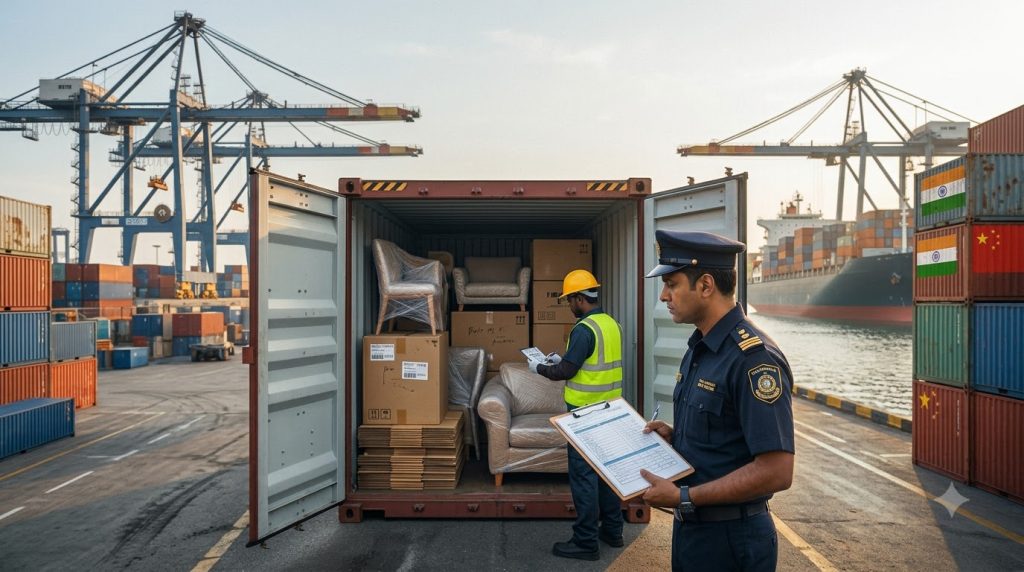
Furniture imported from China into India pays 25% customs duty plus 18% IGST, a combined 47.5% of the assessable (CIF) value. The 25% is made up of 20% Basic Customs Duty (BCD) and a 5% Agriculture Infrastructure and Development Cess (AIDC). The Social Welfare Surcharge (SWS) has been exempted on furniture since 2 February 2025.
Four facts every importer should know:
1. No China discount: India has no free trade agreement with China, so Chinese furniture generally pays the full standard Most-Favoured-Nation (MFN) customs duty rate.
2. IGST is recoverable, customs duty is not: A GST-registered business can usually claim the 18% IGST as input tax credit, making the 25% customs duty its non-recoverable cost.
3. BIS certification is now mandatory: Since 13 February 2026, work chairs, general chairs and stools, tables and desks, storage units, beds and bunk beds must carry the ISI mark. This means the Chinese factory needs a BIS licence before the goods can be sold in India.
4. Budget 2026 changed nothing for furniture: The Finance Bill 2026 left Chapter 94 duty rates unchanged, so the February 2025 duty structure still applies as of October 2026.
How India Classifies Furniture: HS Chapter 94
The customs duty you pay depends on the HS code declared on your Bill of Entry, making product classification the first important decision. Indian customs uses the 8-digit ITC-HS tariff system, which follows the international Harmonized System at the first six digits. Almost all furniture products fall under Chapter 94.
| HS Heading | What it covers | Typical products from China |
| 9401 | Seats and their parts | Office chairs, gaming chairs, sofas, recliners, dining chairs, and bar stools. |
| 9402 | Medical, surgical, dental, and barber furniture. | Hospital beds, dental chairs, and salon chairs. |
| 9403 | Other furniture items and furniture parts. | Tables, desks, beds, wardrobes, cabinets, shelving units, kitchen furniture, and TV units. |
| 9404 | Mattress supports, mattresses, and bedding. | Mattresses, cushions, quilts, and pillows. |
| 9405 | Luminaires and lighting fittings. | Chandeliers, floor lamps, and LED panel lights. |
Within heading 9403, the sub-heading depends on the material and intended use of the furniture. The main classifications include metal office furniture (9403 10), other metal furniture (9403 20), wooden office furniture (9403 30), wooden kitchen furniture (9403 40), wooden bedroom furniture (9403 50), other wooden furniture (9403 60), plastic furniture (9403 70), bamboo, rattan and similar materials (9403 82 to 9403 89), and parts (9403 91 for wooden parts and 9403 99 for other parts).
Three classification traps catch first-time importers:
1. Wooden chairs are not classified under 9403: All seats, regardless of material, fall under heading 9401. For example, upholstered seats with wooden frames fall under 9401 61, while non-upholstered seats fall under 9401 69.
2. Loose fittings fall outside Chapter 94: Drawer slides, hinges and handles shipped separately are generally classified as base-metal fittings under heading 8302, where China-specific anti-dumping duties may apply.
3. Flat-pack furniture is still furniture: Ready-to-assemble kits are generally classified as the finished article rather than as parts when presented together and possessing the essential character of the finished furniture.
Import Duty Rates on Chinese Furniture, Component by Component
For headings 9401, 9403, 9404 and 9405, the effective rates since 2 February 2025 have been 20% Basic Customs Duty (BCD) and 5% Agriculture Infrastructure and Development Cess (AIDC), with the Social Welfare Surcharge (SWS) exempted.
The Finance Ministry’s Budget 2025 explainer confirms this treatment for Chapter 94, citing Serial No. 32 of Notification 4/2025-Customs, Serial No. 16D of Notification 6/2025-Customs, and Notification 7/2025-Customs (CBIC TRU letter, 1 February 2025).
The standard BCD tariff rate was subsequently reduced from 25% to 20%, effective 1 May 2025. The 20% BCD rate now applies directly under the First Schedule.
| Component | Rate | Charged on | Recoverable by a GST-registered importer? |
| Basic Customs Duty (BCD) | 20% | Assessable Value (AV) | No |
| Agriculture Infrastructure and Development Cess (AIDC) | 5% | Assessable Value (AV) | No |
| Social Welfare Surcharge (SWS) | Nil (exempt since 2 February 2025). | Not levied. | Not applicable |
| Integrated Goods and Services Tax (IGST) | 18% for most furniture; 5% for furniture made wholly of bamboo, cane, or rattan. | Assessable Value + Basic Customs Duty (BCD) + Agriculture Infrastructure and Development Cess (AIDC) | Yes, eligible for input tax credit (ITC). |
| Anti-dumping duty | No anti-dumping duty on finished furniture; USD 422 per tonne on Chinese drawer slides (heading 8302). | Weight | No |
| Total import duty on most furniture | 47.5% of assessable value | 25% is a non-recoverable cost. |
The entire import tax calculation can be simplified into one formula:
Total Import Tax = AV × [0.20 + 0.05 + 0.18 × (1 + 0.20 + 0.05)] = AV × 0.475
The assessable value (AV) is the transaction value plus freight and insurance up to the Indian port, as per the Customs Valuation (Determination of Value of Imported Goods) Rules, 2007. Customs authorities can reject a declared price that appears too low for the product, which is a common cause of delays when importing budget furniture from China.
IGST rates follow GST 2.0, effective from 22 September 2025. Wooden, metal, plastic, glass and stone furniture attract 18% IGST, while furniture made wholly of bamboo, cane or rattan attracts 5%. Mattresses and bedding under heading 9404 are taxed at 18% (TaxGamma, Bajaj Finserv).
For bamboo or rattan furniture, the total import tax therefore comes to 31.25% of the assessable value.
Worked Example: Landed Duty on ₹20 Lakh Worth of Chinese Office Chairs
A container of office chairs (HS 9401) with an assessable value of ₹20,00,000 pays ₹9,50,000 in import taxes at customs, of which ₹5,00,000 is a permanent cost.
This example assumes that the CIF value has already been converted using the CBIC-notified exchange rate and that the chairs have a valid BIS licence.
| Step | Calculation | Amount( in rupees) |
| Assessable value (CIF) | Invoice + freight + insurance | 20,00,000 |
| Customs Duty | 20% × 20,00,000 | 4,00,000 |
| AIDC | 5% × 20,00,000 | 1,00,000 |
| Social Welfare Surcharge | Exempt | 0 |
| Customs duty subtotal | BCD + AIDC | 5,00,000 |
| IGST Base | 20,00,000 + 5,00,000 | 25,00,000 |
| IGST | 18% × 25,00,000 | 4,50,000 |
| Total paid at customs | 5,00,000 + 4,50,000 | 9,50,000 (47.5%) |
| Less IGST input tax credit | GST-registered importer only | 4,50,000) |
| Net non-recoverable duty | 5,00,000 (25%) |
Under the pre-February 2025 structure (25% BCD plus 10% Social Welfare Surcharge on the BCD), the same shipment would have paid ₹10,09,000, or 50.45% of the assessable value. The revised structure saves ₹59,000 on this consignment and reduces the non-recoverable portion from 27.5% to 25%.
Two additional costs should be budgeted separately: port, Container Freight Station (CFS), and customs-broker charges; and the working capital tied up in IGST until it can be claimed as input tax credit against output GST. Buyers without GST registration cannot claim this credit, making the full IGST amount a real cost.
Goods genuinely imported for personal use may instead fall under heading 9804. Budget 2026 reduced its tariff rate from 20% to 10%, effective 1 April 2026, with the Social Welfare Surcharge now applicable (CBIC TRU letter, 1 February 2026). Confirm eligibility with your customs broker before relying on this classification.
What Is Different When Furniture Comes from China?
The tariff rate is the same for all countries without a preferential trade agreement, but three China-specific factors affect the cost and risk of importing furniture.
1. No preferential rate is available
India has no free trade agreement with China and stayed out of the Regional Comprehensive Economic Partnership (RCEP) in 2019. Therefore, Chinese-origin furniture generally pays the standard Most-Favoured-Nation (MFN) rate.
Routing Chinese goods through an ASEAN country does not automatically qualify them for India’s ASEAN FTA rates. Preferential treatment depends on genuine origin, which customs authorities can verify under the Customs (Administration of Rules of Origin under Trade Agreements) Rules, 2020 (CAROTAR).
2. Anti-dumping duty on drawer slides
India has not imposed anti-dumping duty on finished furniture under headings 9401 or 9403 from China, based on the DGTR and WTO records reviewed. However, an anti-dumping duty applies to a common furniture component:
- Product: Telescopic channel drawer slides, HS codes 8302 41, 8302 42 and 8302 49.
- Rate: Up to USD 422 per tonne for Chinese producers not individually excluded; several named Chinese exporters have a nil rate.
- Legal basis: Notification 27/2024-Customs (ADD), dated 18 December 2024, replacing the provisional duty of USD 614 per tonne imposed from 27 June 2024.
- Duration: Five years from 27 June 2024, continuing until June 2029 unless revoked, according to the WTO Trade Remedies Data Portal.
This is particularly relevant when importing modular kitchens, wardrobes and office storage as knock-down kits with hardware packed separately.
3. BIS certification under the Furniture QCO
The Furniture (Quality Control) Order, 2025 introduces an important compliance requirement for Chinese furniture imports. It requires six categories of furniture to conform to the applicable Indian Standards and carry the ISI mark, according to Standphill India’s summary of the Gazette orders. Imported products covered by the order must meet the applicable certification requirements before being sold in India.
| Category | Indian Standard |
| Work Chairs | IS 17631:2022 |
| General purpose chairs and stools | IS 17632:2022 |
| Table and Desks | IS 17633:2022 |
| Storage units | IS 17634:2022 |
| Beds | IS 17635:2022 |
| Bunk Beds | IS 17636:2022 |
The order was notified as S.O. 801(E) on 13 February 2025 and took effect on 13 February 2026, with micro and small Indian enterprises given an extension until 13 August 2026. A Chinese factory must obtain a licence through the Bureau of Indian Standards (BIS) Foreign Manufacturers Certification Scheme (FMCS), appoint an Authorised Indian Representative, pass product testing, and undergo a BIS factory inspection.
The transitional relief for goods shipped before the deadline required a Bill of Entry by 12 August 2026 and has now closed. In practice, uncertified chairs, tables, storage units, and beds covered by the order can no longer be cleared for sale in India.
Products outside the six specified categories, such as settees and sofas, reclining and rocking chairs, mattresses, and lighting, are not covered by this order, although other standards may apply.
Step-by-step clearance checklist
A commercial furniture import from China typically clears in seven steps. Most delays occur at steps 3 and 4.
1. Obtain an Importer Exporter Code (IEC). Apply through the Directorate General of Foreign Trade (DGFT) portal. An IEC is required for commercial imports.
2. Register for GST. Register in the state where the goods will be received so that eligible IGST paid at the port can be claimed as input tax credit.
3. Confirm the HS code and BIS requirements before paying the supplier. Request the factory’s BIS licence number (CM/L) under IS 17631 to IS 17636 and verify it on the BIS portal. If the product is covered by the order and the factory is uncertified, do not ship.
4. Collect the shipping documents. These include the commercial invoice, packing list, bill of lading, and insurance certificate. For solid wood furniture or wooden crates, obtain the required fumigation certificate and ensure the packaging complies with ISPM 15 marking requirements where applicable.
5. File the Bill of Entry on ICEGATE. This is usually handled through a licensed customs broker. Declare the correct HS code, value, and country of origin. Customs duty is self-assessed and paid electronically.
6. Complete customs examination and obtain Out of Charge. Customs may inspect the goods, compare the declared value with similar imports, or verify the ISI marking.
7. Claim eligible IGST credit. Include the eligible credit in your GST return and retain the Bill of Entry for audit purposes.
Budget 2026 also changed the deferred customs duty payment cycle for eligible importers from fortnightly to monthly, helping regular importers manage cash flow (CBIC TRU letter, 1 February 2026).
How much furniture India buys from China, and the alternatives
China supplies nearly 70% of India’s furniture imports, mostly in the mid-market, according to furniture research firm CSIL (World Furniture Online, Aug 2025). Imports are still a small slice of a large market: CSIL values Indian furniture consumption at about USD 22 billion, the world’s fourth-largest, with imports meeting only 8% of it.
India’s 2025 imports from China under Chapter 94 totalled USD 1.02 billion, per UN COMTRADE data (Trading Economics).
| Chapter 94 category (2025) | Imports from China(USD million) |
| Other furniture (9403) | 359.78 |
| Lamps and lighting fittings (9405) | 349.07 |
| Seats (9401) | 220.26 |
| Medical and dental furniture (9402) | 46.36 |
| Prefabricated buildings (9406) | 31.56 |
| Mattress supports and bedding (9404) | 14.77 |
For buyers weighing alternatives, the trade-offs are straightforward. ASEAN suppliers such as Vietnam and Malaysia can qualify for a preferential rate under the ASEAN-India FTA if the goods meet its origin rules and carry a valid certificate of origin. Check the exact tariff line in Notification 46/2011-Customs before calculating costs. Domestic manufacturers avoid customs duty entirely. Whatever the source, the BIS requirement applies equally to imported and Indian-made furniture in the six notified categories, so certification is no longer a China-only hurdle.
What changed, and when
The duty rate has been stable since February 2025; nearly every change since then has been on the compliance side.
| Date | Change | What it means for Chinese furniture |
| 25 Jun 2026 | Transition Facilitation (Quality Control)Order, S.O. 3417(E) | Risk-based input-sourcing route for established Indianmanufacturers; finished furniture still needs the ISI mark |
| 13 Aug 2026 | Furniture QCO applies to micro and smallIndian enterprises | Domestic competitors now face the same certification bar |
| 12 Aug 2026 | Bill of Entry deadline for in-transit relief | Uncertified consignments shipped before 13 Feb 2026 canNo longer use the relief |
| 2 Mar 2026 | Furniture QCO Second Amendment, S.O. 1125(E) | Relief for consignments shipped or ordered before enforcement |
| 13 Feb 2026 | Furniture QCO enforced for medium and large enterprises | BIS licence mandatory for six furniture categories |
| 12 Feb 2026 | Furniture QCO First Amendment, S.O. 774(E) | R&D imports up to 200 units a year; 12-month window to sell declared stock |
| 1 Feb 2026 | Union Budget 2026 | No change to Chapter 94; personal-use imports (9804) cut to10% from 1 Apr 2026 |
| 22 Sep 2025 | GST 2.0 rate rationalisation | Furniture 18%; bamboo, cane and rattan 5%; bedding raised to 18% |
| 1 May 2025 | Finance Act 2025 tariff change | Tariff rate on 9401, 9403, 9404, 9405 cut from 25% to 20% |
| 13 Feb 2025 | Furniture QCO notified, S.O. 801(E | Twelve-month countdown to mandatory BIS certification |
| 2 Feb 2025 | Budget 2025 effective rates | 20% BCD + 5% AIDC, SWS exempt; total incidence falls from50.45% to 47.5% |
| 18 Dec 2024 | Definitive anti-dumping duty, Notification 27/2024-Customs (ADD) | Up to USD 422 per tonne on Chinese telescopic drawer slides |
Dates to watch next: The declared-stock clearance window under the First Amendment runs until about 12 February 2027. Budget 2027 will be presented in February 2027, and the drawer-slide anti-dumping duty expires in June 2029 unless extended.
The process of importing furniture from China to India involves a lot of steps, such as the import duties and other taxes, shipping, insurance, etc. The import duty rates depend on the type of furniture and HS code, so confirm the rates before ordering.
Stories International guides companies through sourcing furniture from China to India, including supplier evaluation, quality control, logistics arrangements and import planning. Armed with effective sourcing and knowledge of landed costs, companies can buy smart, help ensure delivery timelines and keep their furniture import budgets on track.
Frequently asked questions
What is the import duty on furniture from China to India in 2026?
Most furniture from China pays 20% Basic Customs Duty, 5% AIDC and 18% IGST, a total of 47.5% of the assessable value. Social Welfare Surcharge has been exempted on furniture since 2 February 2025.
Is the duty different for furniture from China compared with other countries?
The tariff rate is the same, but China cannot claim any preferential rate because India has no trade agreement with it. Imports from ASEAN countries may qualify for lower rates under the ASEAN-India FTA if they meet its origin rules.
What is the HS code for furniture imported into India?
Seats and chairs are HS 9401, and most other furniture, including tables, beds, wardrobes and cabinets, is HS 9403. Mattresses and bedding are 9404, and lamps and lighting are 9405.
Can I claim back the IGST on imported furniture?
Yes, a GST-registered business can usually claim the IGST paid at customs as input tax credit if the furniture is used for business. The 25% customs duty (BCD plus AIDC) cannot be claimed back.
Is BIS certification mandatory for furniture imported from China?
Yes, for work chairs, general chairs and stools, tables and desks, storage units, beds and bunk beds. Since 13 February 2026, these must carry the ISI mark, so the Chinese manufacturer needs a BIS licence under the Foreign Manufacturers Certification Scheme.
Is there anti-dumping duty on Chinese furniture?
Not on finished furniture. India does levy up to USD 422 per tonne on telescopic drawer slides from China, which affects knocked-down kitchens, wardrobes and office storage shipped with separate hardware.
Did Budget 2026 change import duty on furniture?
No. The CBIC’s Budget 2026 explainer lists no change for Chapter 94, so the February 2025 rates still apply as of October 2026.
How is customs duty on furniture calculated?
Multiply the CIF value by 25% for customs duty, then charge 18% IGST on the CIF value plus that duty. For ₹1,00,000 of furniture, that is ₹25,000 duty plus ₹22,500 IGST, or ₹47,500 in total.