
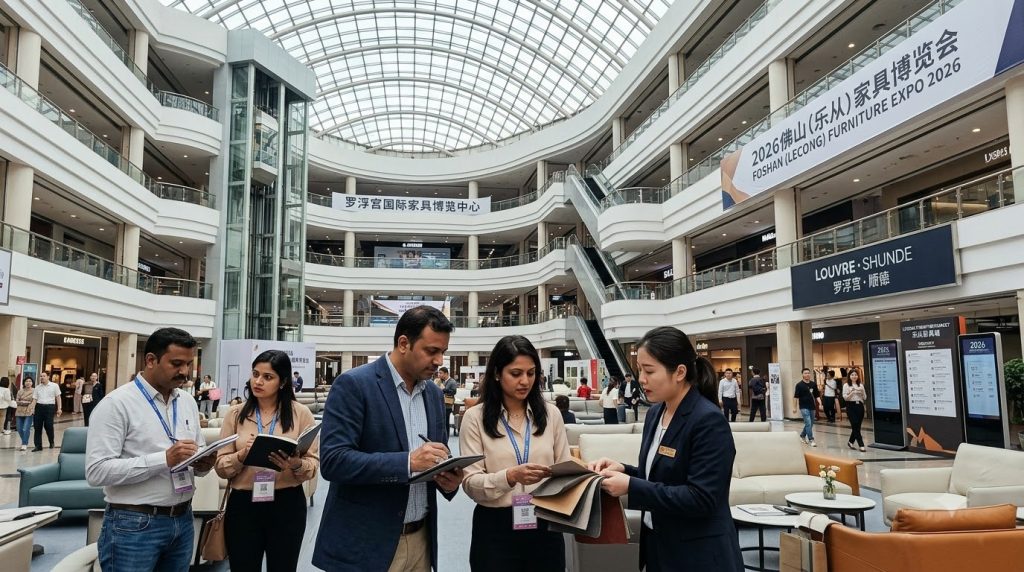
The Foshan furniture market is a 10+ km furniture trading district in Lecong Town, Shunde District, Foshan (Guangdong, China) with 5,000 furniture sellers. Indian buyers usually start at the Louvre International Furniture Exhibition Center for premium brands, compare prices in the Sunlink, Empire and Red Star Macalline malls then visit factories in Longjiang. Plan 3 to 5 days foshan furniture sourcing trip with Stories international a L or M visa and a landed-cost check for 20% basic customs duty 18% IGST and BIS certification, on chairs and tables.
Where is the Foshan furniture market, and how is it organised?
The Foshan furniture market is located in Lecong Town. Lecong Town is part of Shunde District. Shunde District is in the city of Foshan. Foshan is in Guangdong Province. Foshan is part of the Pearl River Delta manufacturing belt. The Pearl River Delta manufacturing belt is next to Guangzhou. It takes two hours by road to get from Foshan to Shenzhen. Indian buyers often say “Foshan” “Shunde” and “Lecong” as if they mean the place. “Foshan” is the city. “Shunde” is the district. “Lecong” is the town. They are three levels of one address.
Guangdong Province (广东): China’s largest export province and home of the Canton Fair.
Foshan (佛山): a prefecture-level city with five districts: Chancheng, Nanhai, Shunde, Sanshui and Gaoming.
Shunde District (顺德):It is the furniture district. It holds both the trading town and the factory town.
Lecong (乐从): It is the furniture trading town. Malls, showrooms and wholesalers line National Highway 325 for more than 10 km.
Longjiang (龙江): the factory town next door. This is where most Lecong showrooms actually make their furniture.
Chancheng and Nanhai: better known for ceramic tiles, sanitaryware, lighting and aluminium, useful if your project also needs these.
The practical rule is simple. Lecong is where you compare furniture and Longjiang is where you negotiate and inspect. First- time Indian buyers waste time by going only to malls and never seeing a factory floor.
Lecong furniture market: what Indian buyers will find
Lecong International Furnishing City (乐从家具城) is the furniture trading area in China with around 5,000 sellers spread over more than 3 million square metres of malls and roadside showrooms. It is not one building. It is a stretch of malls along National Highway 325 each with its own price level and buyer type.
The malls Indian buyers visit most:
• Sunlink Furniture City North (顺联家具城北区): 1 kilometre north of Louvre. Mainly retail mid‑range, younger designs. Similar styles to Louvre often sell here for about half the price (JingSourcing).
• Sunlink Furniture City South (顺联家具城南区): wholesale‑focused serving e‑commerce sellers and export buyers. Prices can be about half of Sunlink North. Check the buildings, not just the shops on the road.
• Shunde Empire Furniture City (顺德皇朝家私): opposite Louvre. Mid‑range home and hotel furniture, a stop for Indian hotel and serviced‑apartment projects.
• Red Star Macalline Lecong (红星美凯龙): opened in 2009, 120,000 square metres, roughly 3 kilometres from Louvre (Uchify). Mid‑to‑high‑end European classical styles; most stores are linked to their own factories in Longjiang.
• Budget wholesale malls: Dongheng (东恒家具城) Dongming (东鸣国际家具城) and Nanhua (南华国际家具城), for sourcing.
Lecong works best as a comparison space. Photograph every piece with the shop’s business card. Note the material and foam specification. Ask whether the seller can take you to the factory. A showroom that cannot show you its factory is usually a trader. That is not a problem. It changes how you negotiate.
Louvre Furniture Mall: the premium benchmark
The Louvre International Furniture Exhibition Center (罗浮宫国际家具博览中心) is a six-floor 380,000 m² furniture mall in Lecong. It is an expensive market in Foshan. It is the landmark most buyers see when they enter Lecong on National Highway 325.
• Floors 1 to 4: over 2,000 brands arranged in themed pavilions (modern neoclassical bedroom, dining, upholstery).
• Floors 5. 6: International luxury labels such as Fendi Casa, Bentley Home and Armani. The sixth floor is by appointment booked about 30 minutes ahead (JingSourcing, Uchify).
• Official site: louvre-mall.com.
How Indian buyers should use Louvre:
Treat Louvre as a design and quality benchmark, not your shop. Spend half a day here to fix the style, finish and comfort level you want. Then look at Sunlink, Empire or a Longjiang factory for a lower price. Luxury villa owners in Kerala, Hyderabad, Bengaluru and Mumbai do buy at Louvre directly. They mainly buy statement sofas, Italian-style beds and dining sets where brand and finish matter more than price.
One caution: some Louvre showrooms sell “inspired” versions of European designs. Ask whether a piece is a brand product. Get that in writing before you pay a brand premium.
Shunde beyond the malls: Longjiang factories
Longjiang Town, located next to Lecong in Shunde District is China’s furniture production base. Industry estimates suggest there are more than 20,000 factories and workshops in the area. Factory-direct prices here are often 25% to 50% lower than showroom prices for furniture of similar quality (Uchify, JingSourcing).
What Longjiang offers that the malls do not:
• Customisation: You can resize a dining table, change the sofa leather or fabric, adjust foam density or even build furniture based on your architect’s drawings.
• Quality control at source: You get to see the frame timber, plywood grade, foam, springs and finishing line before placing your order.
• Materials supply: Longjiang is also a trading hub for upholstery fabric, leather, hardware and panels. This makes it especially useful for interior contractors who manufacture locally.
• A furniture fair: It features local factory brands ranging from modern luxury to New Chinese style.
Longjiang is not the place for beginners. Factories are spread out. The signs are in Chinese. Many factories require order quantities. It’s best to go with a list of shortlisted factories from your visit to Lecong, not with a map.
Shunde itself is also the home of Midea Group and a major home-appliance cluster. This means hotel and residential buyers can combine kitchen appliances, lighting (from Guzhen in Zhongshan) and ceramics (from Foshan’s Chancheng and Nanhai districts) all in one container.
Lecong vs Louvre vs Longjiang: which is cheaper and better?
The Louvre is the most expensive and most curated. Lecong’s other malls are mid-priced and easier to compare. Longjiang factories are the cheapest and they require the most effort. The price levels below are relative to Louvre. Come from published buyer guides. Actual quotes depend on material and quantity.
Which Foshan market suits which Indian buyer?
Match the market to your project, not to the biggest name. A Kerala villa owner and a 120-room hotel in Goa need very different routes through Foshan.
| Indian buyer type | Start at | Then go to | What to watch |
| Luxury villa or bungalow owner | Louvre (floors 1 to 4 and 6) | Red Star Macalline, one or two Longjiang factories | Brand authenticity, veneer and leather grade, sofa sizes for Indian rooms |
| Apartment owner furnishing a full home | Sunlink North | Longjiang for custom beds and wardrobes | LCL shipping cost per piece; buy enough to justify the trip |
| Architect or interior designer | Louvre for references | Red Star Macalline, Longjiang | Sample approval, finish codes, drawings signed by the factory |
| Hotel, resort or serviced apartment | Empire Furniture City | Longjiang contract (FF&E) factories | Fire-retardant fabrics, repeat-order consistency, BIS for chairs and desks |
| Restaurant or café | Empire, Dongheng | Longjiang outdoor and seating factories | Stackability, outdoor weather rating, BIS for chairs and tables |
| Office fit-out | Lecong office furniture malls | Longjiang office seating factories | BIS IS 17631 work-chair licence is mandatory |
| Furniture retailer or showroom in India | Sunlink South, Dongheng | Longjiang factories for repeat SKUs | MOQ, private labelling, carton marking, landed margin after duty |
For buyers, the March trade fair season is often more efficient than shopping in malls. That’s because factories bring their full contract ranges and quote prices directly.
Planning a Foshan furniture trip from India
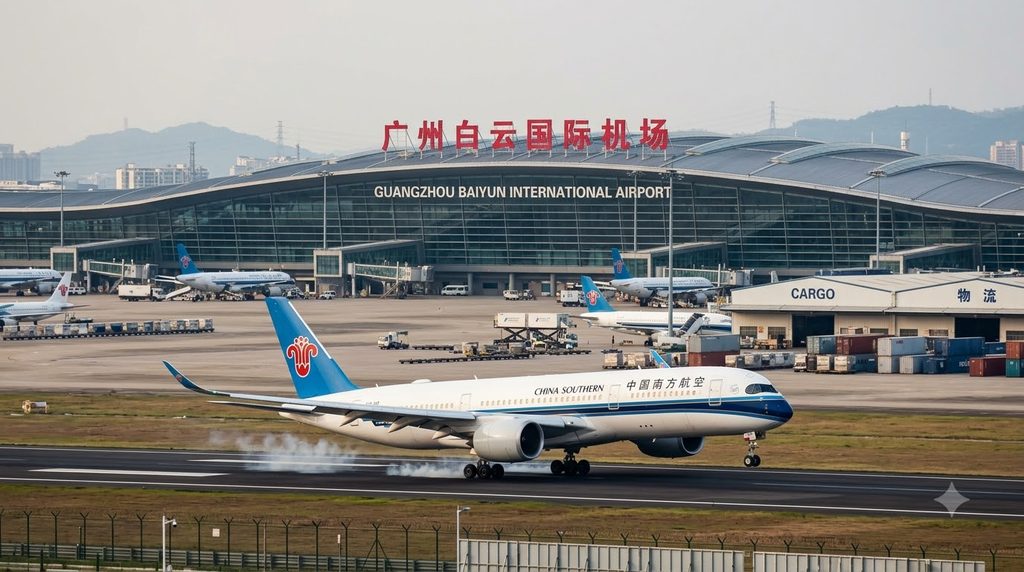
Buyers must get a Chinese visa before traveling. They can fly direct to Guangzhou from Delhi or Kolkata. Should plan to spend three to five days on the ground.
Visa
• Indian passport holders must get a visa in advance. There is no visa on arrival (Visa2Fly).
• Apply online through the Chinese Visa Application Service Center (CVASC). Book an appointment then go in person to submit biometrics.
• Use an L visa for a buying trip or an M visa for business sourcing. An M visa requires an invitation letter from a company. Your sourcing agent or a factory can issue this letter.
• Approximate fees in 2026: about ₹4,851 for an entry and between ₹7,851 and ₹10,751 for a multiple-entry business visa. Processing takes four to fifteen days. Always confirm fees on the CVASC website before applying.
Flights and getting to Lecong
• Flights: IndiGo flies daily from Kolkata to Guangzhou (since 26 October 2025) and from Delhi to Guangzhou (since 10 November 2025) (IndiGo).
• From South India: Buyers from Kochi, Kozhikode, Bengaluru, Chennai and Hyderabad usually connect through Singapore, Kuala Lumpur, Bangkok or Colombo to reach Guangzhou Baiyun (CAN).
• Airport to Lecong: The drive takes one to one and a half hours by car depending on traffic. Most buyers stay in Lecong or central Shunde to reduce travel time.
Money and phone
• Foshan sellers work cashless using Alipay and WeChat Pay. Both now accept cards linked to your account. Set them up before you fly.
• Install WeChat: This is how showrooms share catalogues, prices and production photos after you leave.
Best Time To Go:
| Window | Why it matters |
| 18 to 21 March 2027 | CIFF Guangzhou Phase 1 (home furniture, outdoor, soft furnishings) at the Canton Fair Complex, Pazhou |
| 28 to 31 March 2027 | CIFF Guangzhou Phase 2 (office, hotel and commercial furniture) |
| September to November | Pleasant weather, full factory capacity, orders ship before year-end |
| Avoid: mid-January to early March 2027 | Chinese New Year falls on 6 February 2027; factories close for 1 to 3 weeks and take weeks to ramp back |
| Avoid: 1 to 7 October | China’s National Day Golden Week; travel and hotels are crowded |
Prices, MOQ, payment and negotiation
Foshan furniture is often 30% to 50% more expensive than similar imported furniture sold by stores before shipping and taxes (Tonlexing). For buyers the actual savings depend on what is left after about 44% in import taxes and shipping costs so the best savings come from expensive items, custom designs and full-container orders.
– Minimum order quantity (MOQ)
Lecong retail malls sell single furniture items. But some wholesale malls and Longjiang factories often require a minimum count per design or per fabric for custom sizes. Combining factories into one container via a consolidation warehouse is the usual way to handle this.
– Standard payment terms
A deposit ( 30%) to start production and the remaining amount before loading is the usual approach. Pay by bank transfer to the company’s account matching the name on the pro-forma invoice. Avoid sending amounts to personal Alipay or WeChat accounts.
– Incoterms to understand
EXW (you collect from the factory) FOB (seller loads at the port) and CIF (seller pays shipping and insurance to your Indian port). Indian customs duty is based on the CIF value.
Tips that work when negotiating in Lecong:
• Never agree to the price; ask for the “export price” and the cost for your full order.
• Discuss both the features and the price: foam density, frame wood, leather quality, hardware brand.
• Get a formal invoice that lists material, measurements, finish code, packing method and delivery date.
• Take business cards and take photos of each item with its label so you can compare malls the same night.
Shipping to India import tax and BIS certification
Most furniture under HS code 9403 is subject to 20% customs tax in India plus social welfare fee and 18% IGST and chairs, stools, tables and desks now also need a BIS certificate.
BIS certification (Furniture Quality Control Order)
•Since 13 February 2026 these products must carry the BIS Standard Mark under a licence: IS 17631:2022 work chairs IS 17632:2022 general-purpose chairs and stools and IS 17633:2022 tables and desks (PlyReporter).
• Foreign factories need their BIS licence. Before paying a deposit for office chairs, dining chairs, bar stools, desks or tables ask the factory for its BIS licence number. Check it on the BIS website.
• A 180-day transition for consignments shipped before the order took effect was added in March 2026 (IndiaLaw); that window has now closed.
• Indian Standards also exist for storage units, beds and bunk beds (IS 17634 to 17636). Check whether they are enforced for your product at the time of import.
Shipping and Transit times
• Chinese ports: Foshan, Nansha (Guangzhou) and Shekou or Yantian (Shenzhen).
• Indian ports: Nhava Sheva (JNPT) and Mundra for the west, Chennai and Cochin for the south Kolkata for the east.
• Transit: South China to west India is 12 to 16 days port to port; Foshan, to Chennai averages about 19 days; LCL (shared container) adds roughly 5 to 7 days (YQN, Cogoport).
• Container choice: a 20-foot container suits an apartment; a 40-foot high-cube suits a villa or a hotel floor. Below about 15 m³ LCL is usually cheaper.
• Wood packaging must be heat-treated or fumigated to ISPM-15 standards or Indian plant quarantine can hold the shipment.
8 mistakes Indian buyers make in Foshan
1. Buying at the mall is not a good idea. Louvre prices are a benchmark, not what you will actually pay in the market. Always compare at least three different malls before placing an order.
2. Never skip the factory visit. A showroom sample can be better than the production run. Make sure to inspect the frame, foam quality and finish carefully in Longjiang.
3. Don’t ignore BIS certification. Ordering 200 restaurant chairs from a factory without a BIS licence can cause your shipment to get stuck at customs. Always confirm the licence is valid.
4. Underestimating landed cost is a mistake. Add 44% for import taxes, plus freight, port handling, inland transport and installation. These extra charges add up fast.
5. Not measuring rooms is risky. Chinese sofas and beds are often bigger than what fits in apartments. Always carry floor plans with dimensions when shopping.
6. Vague orders lead to deliveries. Saying “same, as sample” is not enough. Clearly list material type, colour code, exact dimensions and packaging requirements.
7. Paying through accounts is dangerous. Always transfer money to the company account that appears on the invoice. This prevents fraud. Keeps records clear.
8. Skipping -shipment inspection is a big risk. Once the container leaves, fixing problems becomes slow and costly. Inspect all items before making the payment.
How Stories International helps Indian buyers in Foshan
Stories International is a China furniture sourcing company in Kerala for Indian buyers, with offices in Lecong (Foshan) and Kozhikode (Kerala), and 20 years of experience connecting homeowners, architects, hotels and businesses with verified Foshan factories (Stories International).
Its Furniture Tourism program covers the full route described in this guide:
- Initial inquiry: you share requirements and budget.
- Product curation: a shortlist of factories and products that match your style.
- Trip planning: invitation letter, visa support, airport pickup, stay and local travel.
- Factory visits: guided Lecong mall and Longjiang factory visits with translation.
- Procurement: negotiation, order confirmation and production follow-up.
- Quality control: raw material verification, dimensional checks and finish matching before shipment.
- Shipping: packing, loading and shipping to India.
- Installation and review: on-site installation and a final walkthrough.
Beyond furniture, Stories International also sources lighting, carpets, ceramics, sanitaryware and home décor, and works with factories in Turkey, Italy and Indonesia. Buyers who cannot travel can use virtual factory tours.
Plan your Foshan sourcing trip: contact Stories International or WhatsApp +91 86062 32323.
Frequently Asked Questions
What is the Foshan furniture market?
The Foshan furniture market is the furniture trading district of Lecong Town in Shunde District, Foshan, Guangdong, China. It stretches more than 10 km along National Highway 325, holds about 5,000 sellers, and is widely described as the world’s largest furniture distribution centre.
Is Lecong the same as the Foshan furniture market?
Yes, in practice. Lecong is the town inside Foshan’s Shunde District where the furniture malls are located, so buyers use “Lecong furniture market” and “Foshan furniture market” for the same place. The factories that supply it are mostly in neighbouring Longjiang.
What is Louvre Furniture Mall in Foshan?
Louvre Furniture Mall, officially the Louvre International Furniture Exhibition Center, is a six-floor, roughly 380,000 m² premium furniture mall in Lecong. It hosts over 2,000 Chinese brands and international labels such as Fendi Casa and Bentley Home, and is the most expensive market in Foshan.
Is Foshan furniture cheaper than Indian furniture?
Often, for high-value and custom pieces. Foshan prices are commonly 30% to 50% below retail for comparable imported furniture, but Indian buyers pay about 44% in import taxes plus freight. Savings are strongest on sofas, beds, dining sets and full-container commercial orders.
How many days do I need in Foshan to buy furniture?
Plan at least 3 days to see Louvre and the main Lecong malls, and 4 to 5 days if you want to visit Longjiang factories and place orders. Hotel and commercial projects may need a second visit for sample approval.
Do Indians need a visa for China to visit Foshan?
Yes. Indian passport holders need a Chinese L (tourist) or M (business) visa before travel, applied through the Chinese Visa Application Service Center. There is no visa on arrival. An M visa requires an invitation letter from a Chinese company.
How do I reach Foshan from India?
Fly to Guangzhou Baiyun International Airport. IndiGo runs daily direct flights from Delhi and Kolkata to Guangzhou; buyers from South India usually connect via Singapore, Kuala Lumpur, Bangkok or Colombo. Lecong is about 1 to 1.5 hours by road from the airport.
What is the import duty on furniture from China to India?
Most furniture under HS 9403 attracts 20% basic customs duty, a 10% social welfare surcharge on that duty, and 18% IGST. Together these come to roughly 44% of the CIF value. Rates vary by HS code, so confirm on ICEGATE before ordering.
Does imported furniture need BIS certification in India?
Yes, for some products. Since 13 February 2026, work chairs (IS 17631), general-purpose chairs and stools (IS 17632) and tables and desks (IS 17633) must carry the BIS Standard Mark. The Chinese factory must hold its own BIS licence.
How long does shipping from Foshan to India take?
Sea freight from South China takes about 12 to 20 days port to port, depending on the Indian port. Add production time (often 20 to 45 days), customs clearance and inland delivery. Shared-container (LCL) shipments add about 5 to 7 days.
When is the best time to visit the Foshan furniture market?
March, during CIFF Guangzhou (18 to 21 and 28 to 31 March 2027), and September to November are the best windows. Avoid the weeks around Chinese New Year on 6 February 2027 and China’s Golden Week from 1 to 7 October.
Do I need a sourcing agent in Foshan?
Not for browsing, but it helps for buying. An agent handles translation, factory verification, negotiation, quality control, consolidation and shipping, and can check BIS compliance. This matters most for first-time buyers and for commercial projects with deadlines.