
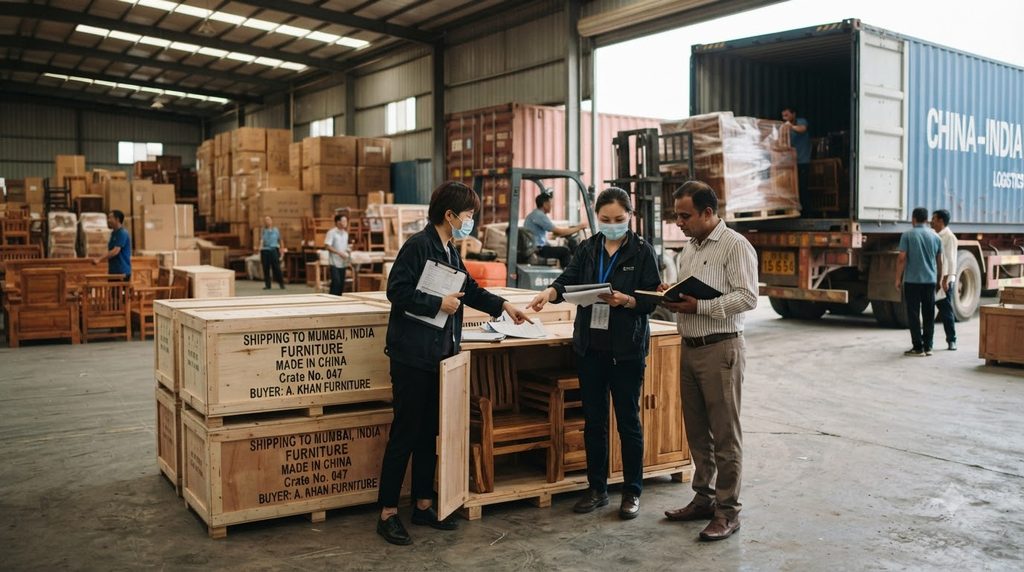
To import furniture from China to India, you need an Importer Exporter Code (IEC) from DGFT, the correct HS code (usually 9401 for seating or 9403 for other furniture), a BIS licence for chairs, tables, storage units and beds, a verified factory, pre-shipment quality inspection, sea freight to an Indian port, and a Bill of Entry filed on ICEGATE. Expect total import taxes of about 47.5% of the CIF value and 45–75 days from order to delivery.
Most Indian buyers and furniture sourcing agents source from Foshan in Guangdong province, China’s largest furniture manufacturing cluster. Lecong Furniture City in Foshan alone has more than 180 furniture malls and around 3,000 manufacturers. This guide walks through each step as it applies in 2026, including the Furniture (Quality Control) Order that changed the rules for imports this year.
Why Indian buyers source furniture from China
China, and specifically Foshan in Guangdong province, offers the widest furniture range at factory prices anywhere in the world. For Indian hotels, offices, restaurants and luxury homes, that means custom sizes, finishes and volumes that are hard to find locally.
Foshan and Lecong Furniture City
Lecong, in Foshan’s Shunde district, began in the 1980s as China’s first dedicated furniture market. According to Guangdong provincial media, it now has more than 180 furniture malls, over 4 million square metres of trading space, 10,000+ distributors and about 3,000 manufacturers ( GDToday). Neighbouring Longjiang and Shunde host many of the factories behind those showrooms.
Canton Fair
The China Import and Export Fair in Guangzhou runs twice a year. Phase 2 of the autumn 2026 session (23–27 October) covers furniture, home décor and building materials ( Sino Business Partner). It is useful for meeting suppliers, but a stand is not a factory audit.
What China does well for Indian projects:
Hospitality and commercial furniture in volume: hotel case goods, banquet chairs, restaurant seating, office workstations
Customisation: fabric, leather, veneer, marble and metal finishes made to your drawings
One-stop sourcing: furniture, lighting, carpets, ceramics and sanitaryware from the same region, consolidated into one container
The trade-off – Import taxes of roughly 47.5%, freight, and BIS certification now add real cost. China makes most sense for design-led, custom or bulk project orders, where the factory price gap outweighs those costs.
How to import furniture from China to India: 10 steps
The import process has ten steps, from registering as an importer to installing furniture on site. Steps 1–3 are paperwork you finish before paying any factory.
Step 1: Register as an importer (IEC, GST, ICEGATE)
Every business importing goods into India needs an Importer Exporter Code (IEC) from the Directorate General of Foreign Trade (DGFT). The IEC is linked to your PAN, costs ₹500 once, and is usually issued in one to three working days on dgft.gov.in ( DGFT fee guide). You must confirm your IEC details free of charge between 1 April and 30 June every year, or it is deactivated.
Also keep your GSTIN active so you can claim the IGST paid at customs as input tax credit, and register on ICEGATE, the CBIC customs portal, or authorise a licensed customs broker to file for you. Individuals importing for genuine personal use are generally exempt from IEC under the Foreign Trade Policy, but customs duty still applies.
Step 2: Classify each item and calculate landed cost
Indian customs duty depends on the 8-digit HS (ITC-HS) code, so classify every item before you negotiate price.
9401: seats, sofas, armchairs, dining and office chairs
9403: tables, beds, wardrobes, cabinets, office and kitchen furniture
9404: mattresses and cushions
Most 9401 and 9403 lines carry about 25% customs duty (Basic Customs Duty 20% + Agriculture Infrastructure and Development Cess 5%) plus 18% IGST (iWishBag tariff table). See the worked landed-cost example below.
Step 3: Check BIS certification under the Furniture QCO
This is the step most 2026 import guides miss. Under the Furniture (Quality Control) Order, 2025 (S.O. 801(E)), six furniture categories must carry the BIS Standard Mark to be imported or sold in India ( Omega QMS).
| Category | Indian Standard |
| Work Chairs | IS 17631 |
| General purpose chairs and stools | IS 17632 |
| Desk and Tables | IS 17633 |
| Storage units | IS 17634 |
| Beds | IS 17635 |
| Bunk Beds | IS 17636 |
The order took effect for medium and large enterprises on 14 February 2026. The transitional relief for goods ordered or shipped before that date ended on 13 August 2026.Today, an import in these categories needs a BIS licence held by the manufacturing factory. Foreign factories must appoint an Authorised Indian Representative (AIR), pass product testing at a BIS-recognised lab and a factory inspection, which takes two to six months.
What to do: ask each Chinese supplier for its BIS licence number and verify it on the BIS portal before you pay a deposit. For sofas, lounge seating and other items at the edge of a category, get a written classification opinion from a BIS consultant.
Step 4: Find and verify the factory
Most Indian buyers find furniture suppliers in three ways: visiting Foshan’s Lecong and Longjiang markets, meeting exhibitors at the Canton Fair, or searching B2B platforms. A showroom is often a trader, not the maker.
Before committing, verify:
– The business licence and Unified Social Credit Code
– That the showroom links to a real factory, with a site visit or video audit of production lines
– Export history to India or similar markets, and references
– BIS licence status for QCO-covered items (Step 3)
Step 5: Approve samples and lock specifications
Written specifications prevent most quality disputes. For each item, fix in writing: Dimensions and tolerances, with drawings
Materials: wood species and moisture content, board type, foam density, fabric or leather grade and abrasion rating, metal gauge and finish
Finish references: approved colour and veneer samples, signed by both sides
Packing standard: carton strength, corner protection, assembly hardware and instructions
Keep one signed “golden sample” at the factory and one with you. Inspectors compare production against it.
Step 6: Sign the contract, choose Incoterms and pay safely
The Incoterm decides who pays freight and insurance and where risk passes (ICC Incoterms 2020). Most furniture buyers use:
– FOB Nansha or Shekou: the factory delivers to the vessel; you or your forwarder book freight. Gives you control of shipping cost.
– CIF Nhava Sheva, Chennai or Cochin: the factory books freight to the Indian port. Simpler, but freight margins are harder to see.
A common payment structure is 30% deposit and 70% balance after pre-shipment inspection, paid by bank transfer through your authorised dealer (AD) bank. From 1 October 2026, RBI’s new Export and Import Regulations remove the fixed six-month deadline for import payments; payment follows your contract terms, and your bank sets the advance-payment threshold above which it may ask for a standby LC or bank guarantee (EY summary of RBI EXIM Guidelines).
Step 7: Inspect quality before shipment
Never pay the balance before an independent inspection. Book at least two checks:
– During production (DUPRO): at 20–30% completion, to catch material or construction errors early
– Pre-shipment inspection (PSI): at 100% completion and 80% packed, checking dimensions, finish against the golden sample, function, and packing
Stories International runs three checks on every order before it leaves the factory: raw material verification, dimensional accuracy and finish matching.
Step 8: Pack, consolidate and ship
Furniture ships by sea; air freight rarely makes sense for bulky items.
– FCL (full container): a 20-foot container holds roughly 25–28 CBM of packed furniture, a 40-foot high-cube roughly 60–68 CBM
– LCL (shared container): for smaller orders, priced per CBM, with more handling risk.
– Consolidation: combine several Foshan suppliers (furniture, lighting, carpets, sanitaryware) into one container at a forwarder’s warehouse.
Wood packaging such as pallets and crates must be ISPM-15 treated and marked, and solid-wood or bamboo items may need fumigation and a phytosanitary certificate under India’s Plant Quarantine Order, 2003 ( EximPe). Insure the cargo for CIF value + 10%. Sea transit from Shekou or Shenzhen to Nhava Sheva usually takes about 15–20 days (Cargo People). Buyers in Kerala often land at Cochin Port’s Vallarpadam terminal; buyers in the north use Nhava Sheva or Mundra; South India uses Chennai.
Step 9: Clear Indian customs
Your customs broker files the Bill of Entry on ICEGATE. Under Section 46 of the Customs Act, it must be filed by the end of the day before the vessel arrives; late filing attracts charges (TaxGuru). Customs then assess duty, you pay online, and the shipment may be examined, including a check of BIS marking on QCO-covered items. After the out-of charge order, the container is released.
Step 10: Deliver, install and claim input tax credit
The container moves from port or ICD to your site by road. Unpack against the packing list, record any transit damage with photos for the insurance claim, and install. If you are GST-registered, claim the IGST paid at customs as input tax credit in your GST return. Basic Customs Duty and AIDC are not creditable.
Import duty on furniture from China: landed cost example
Furniture imported from China into India costs about 1.6× its factory (FOB) price once duty, IGST, freight and port charges are added, or about 1.4× for a GST-registered business that claims input tax credit. Customs calculates duty on the assessable value, which is the CIF value: goods + international freight + insurance. IGST is then charged on the assessable value plus customs duty.
\text{Total tax} = CIF \times 0.25 + (CIF \times 1.25) \times 0.18 = 0.475 \times CIF
| Line | Basis | Amount (₹) |
| FOB value of goods | Supplier invoice | 25,00,000 |
| Ocean freight, Nansha → Nhava Sheva | illustrative | 1,50,000 |
| Marine insurance | 0.5% of FOB | 12,500 |
| Assessable value (CIF ) | 26,62,500 | |
| Basic Customs Duty | 20% of CIF | 5,32,500 |
| AIDC | 5% of CIF | 1,33,125 |
| IGST | 18% of (CIF + duty) | 5,99,063 |
| Total import taxes | 47.5% of CIF | 12,64,688 |
| Port, CFS, broker and delivery order charges | Illustrative | 75000 |
| Inland transport to site | Illustrative | 50,000 |
| Landed Cost | 1.62× FOB | 40,52,188 |
| Landed cost net of IGST credit (GST-registered buyer) | 1.38× FOB | 34,53,125 |
Freight, port and transport lines are illustrative; get live quotes, because container rates on China–India lanes swing sharply by season. Add BIS certification cost where the factory does not already hold a licence, and check the Directorate General of Trade Remedies (DGTR) for any anti-dumping duty on specific components such as glass or hardware.
Documents required to import furniture from China
Customs clearance needs eight core documents; missing or mismatched papers are the most common cause of port delays and demurrage.
| Document | Issued by | Why it matters |
| Commercial invoice | Chinese supplier | Basis of assessable value; must match the Bill of Entry |
| Packing List | Chinese supplier | Carton-wise contents, weights and CBM for examination |
| Bill of Lading | Shipping line or forwarder | Title to goods; consignee must match your IEC name |
| Bill of Entry | Your customs broker, on ICEGATE | Customs declaration for home consumption |
| IEC and GSTIN | DGFT / GST portal | Importer identity; IGST credit |
| BIS licence details | Factory’s BIS licence | Required for chairs, tables, storage, beds and bunk beds under the QCO |
| Insurance certificate | Insurer | Supports CIF value and damage claims |
| Fumigation / phytosanitary certificate and ISPM-15 marks | Treatment provider / China customs | For wood packaging and solid wood or bamboo items |
Customs may also ask for the purchase order, payment proof from your AD bank, product catalogues and technical specifications to confirm classification and value.
8 common mistakes when importing furniture from China
Most failed furniture imports trace back to one of these avoidable errors.
1. Ignoring BIS – Ordering QCO-covered chairs, tables, storage or beds from a factory without a BIS licence. The goods can be held at the port.
2. Paying a trader, not a factory – Lecong showrooms often front several workshops. You lose control over materials and timelines.
3. Vague specifications – “Walnut finish” and “good foam” are not specifications. Fix species, density, grade and tolerances in writing.
4. Paying the balance before inspection – Once the full amount is paid, you have no leverage to fix defects.
5. Underestimating landed cost – Budgeting only for the factory price and freight, then finding 47.5% in taxes at the port.
6. Solid wood without seasoning – Timber dried for a Chinese climate can crack or warp in humid coastal Indian cities like Kochi or Mumbai. Ask for kiln-dried wood at the right moisture content.
7. Weak export packing – Furniture is fragile and bulky. Insist on five-ply cartons, corner guards and foam wrap, and inspect packing at the PSI.
8. Late Bill of Entry. Filing after arrival triggers late charges, and slow clearance adds container demurrage and detention.
Import it yourself or use a China furniture sourcing agent?
Importing directly suits experienced buyers with repeat orders from a known factory. First-time importers and project buyers usually save money and time with a sourcing agent that has staff on the ground in Foshan.
| Tasks | DIY Importer | With Stories International |
| Finding factories | Online search, trade fairs, trial and error | Curated factory and product shortlist matched to your brief and budget |
| China trip | Self-arranged visa, travel, translation | Invitation, visa help, airport pickup, driver and translator through the Furniture Tourism programme |
| Negotiation | Language and pricing barriers | Direct factory pricing, no middlemen or retail markup |
| Quality control | Hire a third-party inspector | Checks at each production stage; raw material, dimension and finish checks before loading |
| Consolidation and shipping | Coordinate each supplier and forwarder | Packing, container loading and shipping to India managed as one chain |
| Installation | Hire local contractors | Stories team installs on site and does a final walkthrough |
Source Furniture with Stories International.
Stories International is a China furniture sourcing company in India for Indian buyers, with 20 years of experience connecting homeowners, architects, hotels and businesses with verified factories in Foshan. It has an office inLecong, Foshan, and an Indian office in Kozhikode, Kerala, and sources from China, Turkey, Italy and Indonesia.
Its eight-stage process covers inquiry, product curation, trip planning, factory visits, procurement, shipping, installation and final review. Categories include furniture, home décor, lighting, carpets, ceramics and sanitaryware, so one trip can furnish an entire hotel or home (Stories International services).
For commercial and workspace projects, Stories for Business extends the same international sourcing across China, Italy and Turkey through Stories Homes, the Kerala premium furniture brand. Next step: plan your Foshan sourcing trip or request a sourcing quote. WhatsApp: +91 86062 32323.